


On Nov. 5, the College of Letters co-sponsored a lecture on “Animal Houses” by guest speaker Trattie Davies, who is an Architect and Senior Critic at the Yale School of Architecture. “Animal Houses” is also a course Davies teaches MA students, exploring the visualisation of space from the perspective and function of non-human animals. The event was held in Boger Room 112.
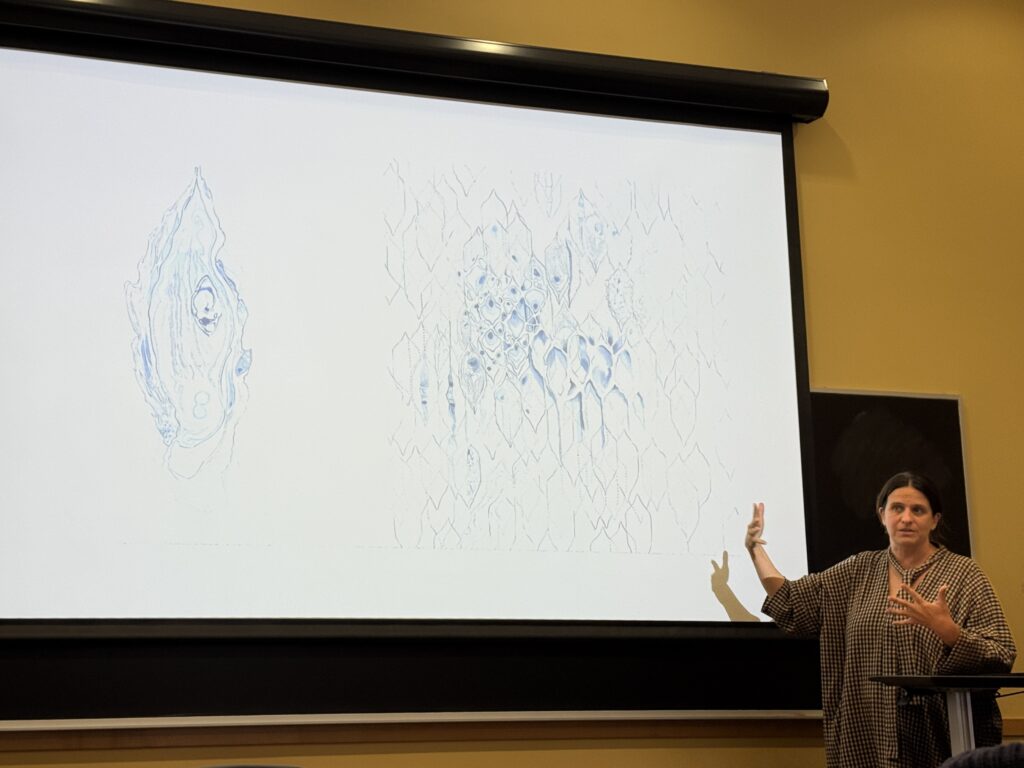
Davies began her presentation with an excerpt from German artist Josef Albersm, which she said makes no sense upon first read but stretches open possibilities for thinking about art and design :
“One and one is two—that’s business.
One and one is four—that’s art—or if you like it better—is life.
I think that makes clear: the many-fold seeing, the many-fold reading of the world makes us broader; wider; richer.
In education, a single standpoint cannot give a solid firm stand.
Thus, let us have different viewpoints, different standpoints.
Let us observe in different directions and from different angles…”
Davies then exemplified the value of looking at architecture from multiple perspectives by presenting two photographs of Swiss-French architect designer Le Corbusier’s “Villa Garches”, a built example of Corbusier’s five points of architecture. The first photograph presented the traditional view of the Villa alone, a model that was to be respected and related.
The second photograph looked at the same model from a different perspective: the weather had changed, the photographer had moved further back, however, Davies called “an awkward view”, where the photographer had moved back, and one could see the occupants engaging in a snowball fight.
“The question is raised, how does life actually take place in space?” Davies asked, adding that closer observation of human spaces becomes more important to understand occupants’ lived history. For non-human animals, however, the case is entirely different.
“But if you look at animals— immediately, the questions of life are vivid and clear. A few years ago, I was like, ‘What is up with animal houses?’ and I had some old students [with me]. And the task was, pick an animal and then let’s meet and discuss.”
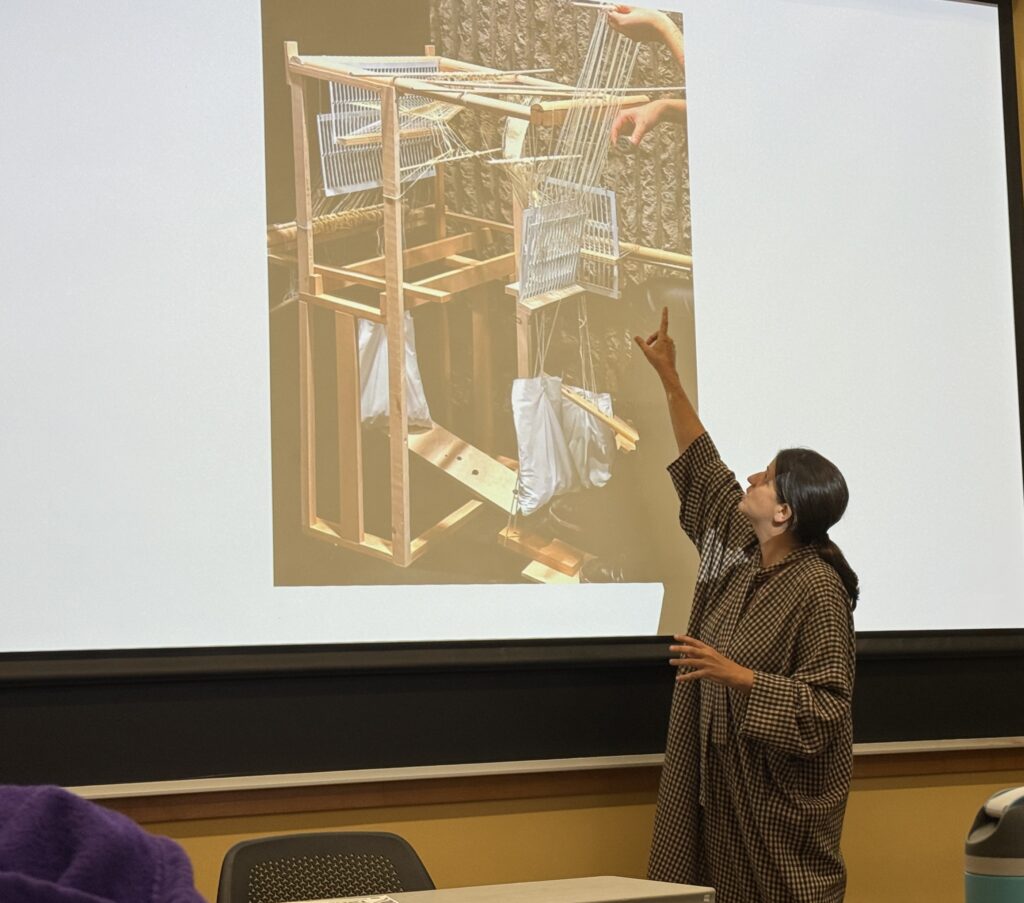
Then Davies transitioned into explaining her students’ final presentation for the course— a collection that ranged from graphic art, audio-visual material, architectural designs, as well handmade woodwork. Students explored how animals occupied space, both temporarily and habitually, through case studies of fire ants, sea sponges, wasp nests, birds, and elk among others.
One example explored the life cycle of the green darner, a dragonfly species found abundantly in North America.
“It’s very hard to piece together this particular animal because it takes three generations to complete its migratory pattern,” Davies said.
It only spends 4 months of its life in flight, and the student presenting assembled the building typologies of the spaces through which the different generations would pass, allowing for a view of the continuum of movement.
Towards the end of the lecture, attendants asked questions about the kinds of material students used to construct their projects, the methodology they used to study behaviours of any given animals, and Davies’ main takeaways from this course.
“For me, architectural design is like putting your foot in the water of a stream just by touching it. You incite an adjustment every day. It is an act of enormous control, with impact on every moment of our existence,” Davies said.
Written by COL Major Janhavi Munde, ’27