

Do you know what a Codex is?
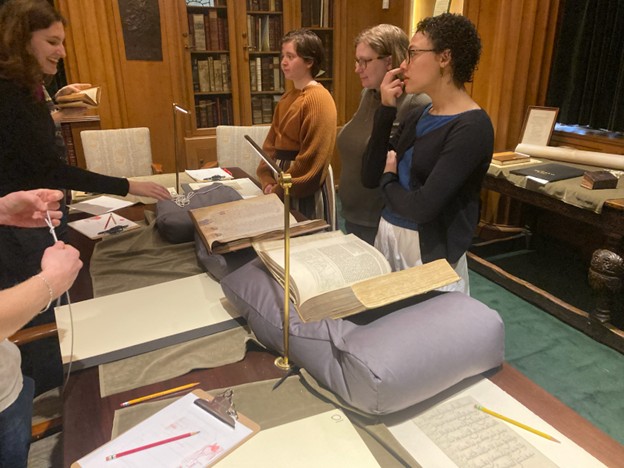
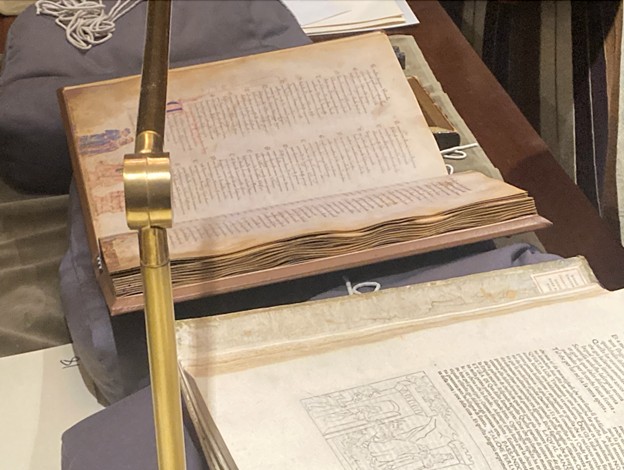
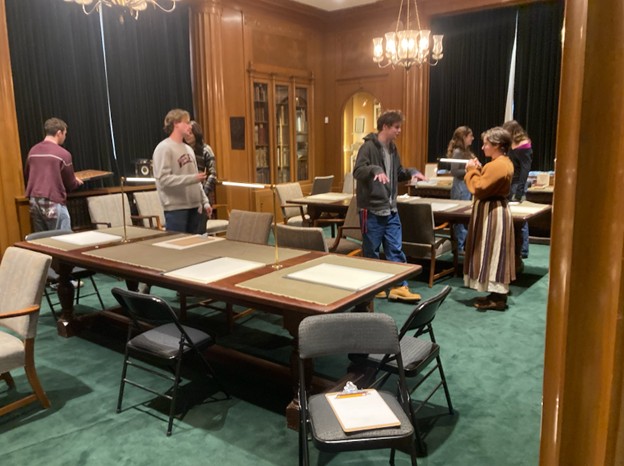
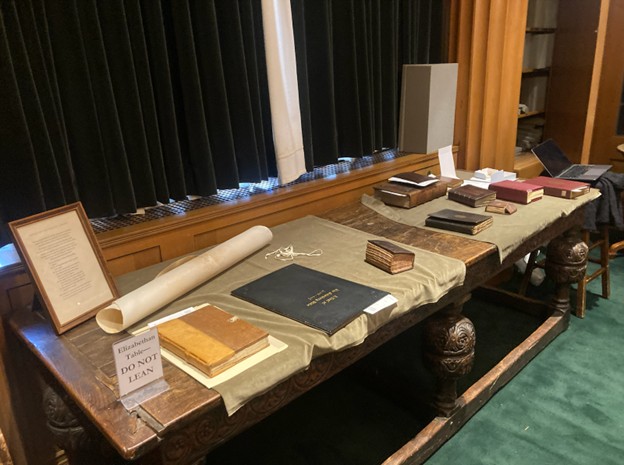
On Wednesday (Feb. 25) COL sophomores visited special collections with Professor Jarada, where Amanda Nelson (University Archivist) showed the class some reconstructions of old medieval book binding methods (done as a COL thesis project by Katherine Parks ’15). She talked about the historical turn from parchment to paper and also showed them the difference between quill and reed pens before ultimately finishing with a discussion of the printing press at the end of the middle ages—the Islamic world already had a massive infrastructure for the creation of manuscripts, and a cursive language that made the adoption of type-set printing difficult, European languages that use the Latin alphabet were much easier to print and so had a much easier time with the press.
Here’s one to bust out next time you’re with the family: In a medieval world with about one hundred different ways to store information (wax tablets, scrolls, etc.) the method of binding we now call a book was referred to as a codex!
Now how difficult do you think it would be for you to replicate a page of these texts? How much harder would it be if you couldn’t see the text, if you had the images and text on the page described to you by a friend of yours? Ask a COL sophomore how difficult that could be, and they could tell you. Through this activity, they learned how much the column spacing varied from page to page, the different forms of notation, and how unique each individual hand-crafted page is.
All in all, they had a fantastic time and learned a ton!
Written by Henry Kaplan, COL Class of 2028