

Learn all about the College of Letters | Meet Faculty & Students
Learn all about the College of Letters | Meet Faculty & Students
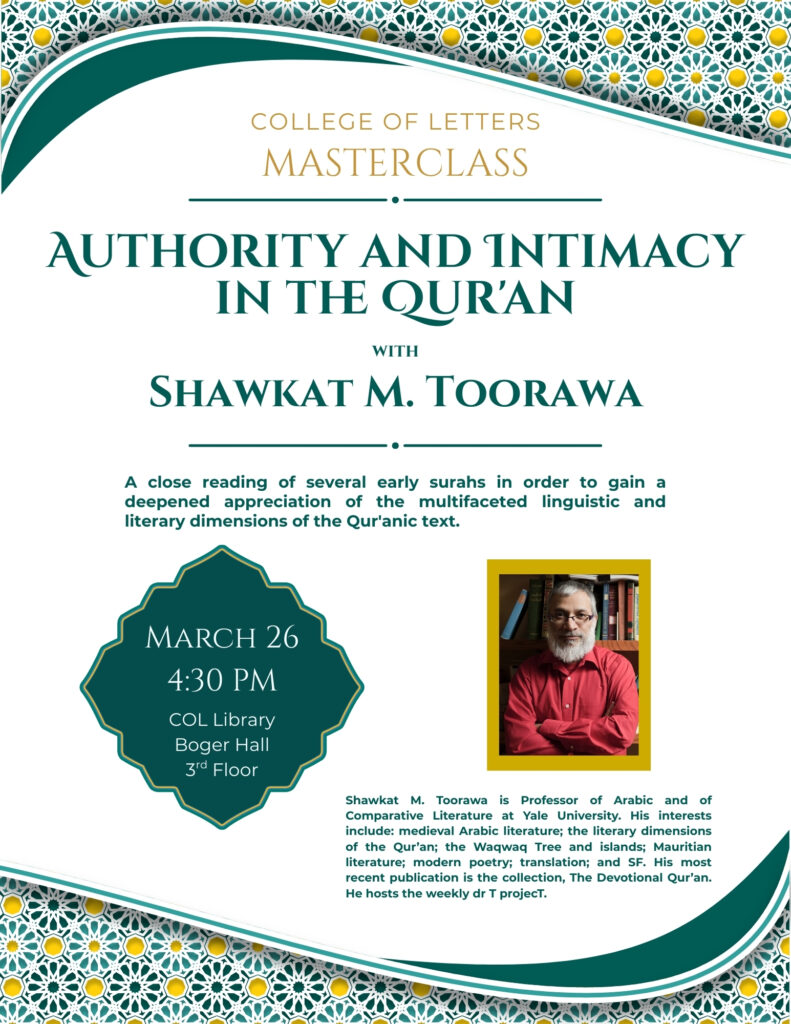
A College of Letters Masterclass – Spring 2026
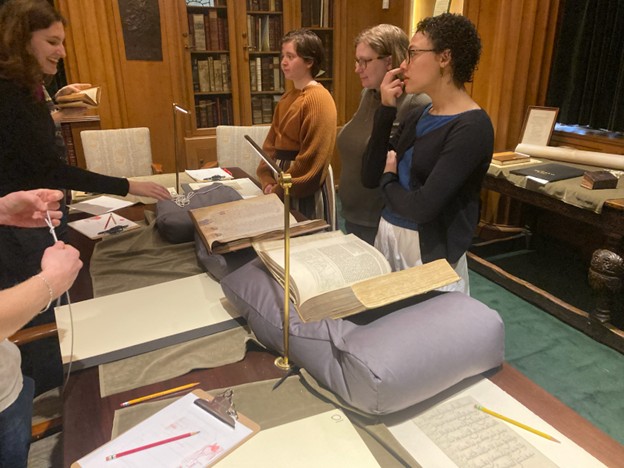
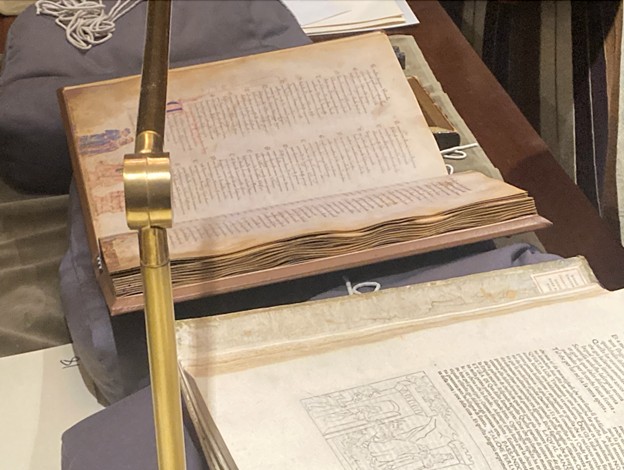
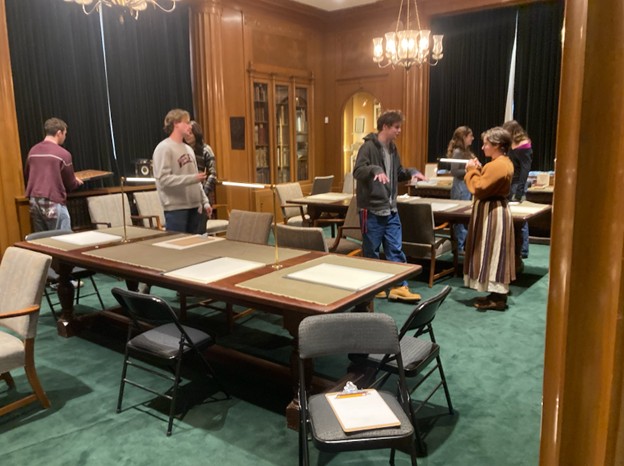
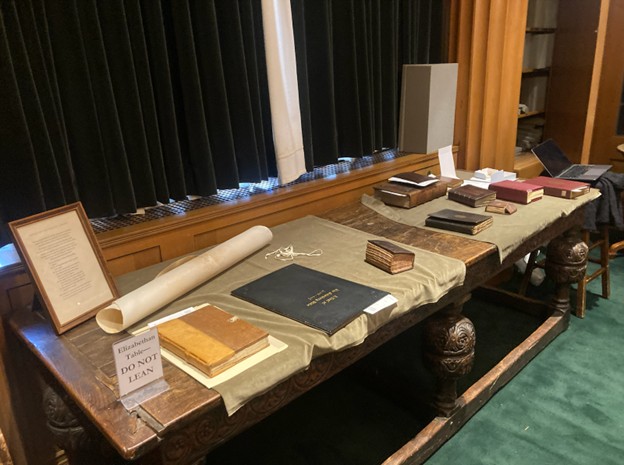
On Wednesday (Feb. 25) COL sophomores visited special collections with Professor Jarada, where Amanda Nelson (University Archivist) showed the class some reconstructions of old medieval book binding methods (done as a COL thesis project by Katherine Parks ’15). She talked about the historical turn from parchment to paper and also showed them the difference between quill and reed pens before ultimately finishing with a discussion of the printing press at the end of the middle ages—the Islamic world already had a massive infrastructure for the creation of manuscripts, and a cursive language that made the adoption of type-set printing difficult, European languages that use the Latin alphabet were much easier to print and so had a much easier time with the press.
Here’s one to bust out next time you’re with the family: In a medieval world with about one hundred different ways to store information (wax tablets, scrolls, etc.) the method of binding we now call a book was referred to as a codex!
Now how difficult do you think it would be for you to replicate a page of these texts? How much harder would it be if you couldn’t see the text, if you had the images and text on the page described to you by a friend of yours? Ask a COL sophomore how difficult that could be, and they could tell you. Through this activity, they learned how much the column spacing varied from page to page, the different forms of notation, and how unique each individual hand-crafted page is.
All in all, they had a fantastic time and learned a ton!
Written by Henry Kaplan, COL Class of 2028
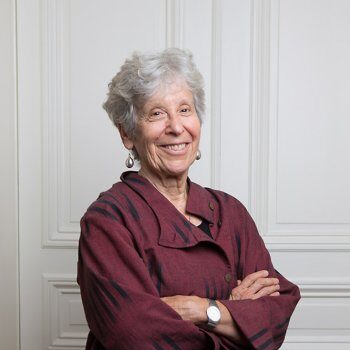
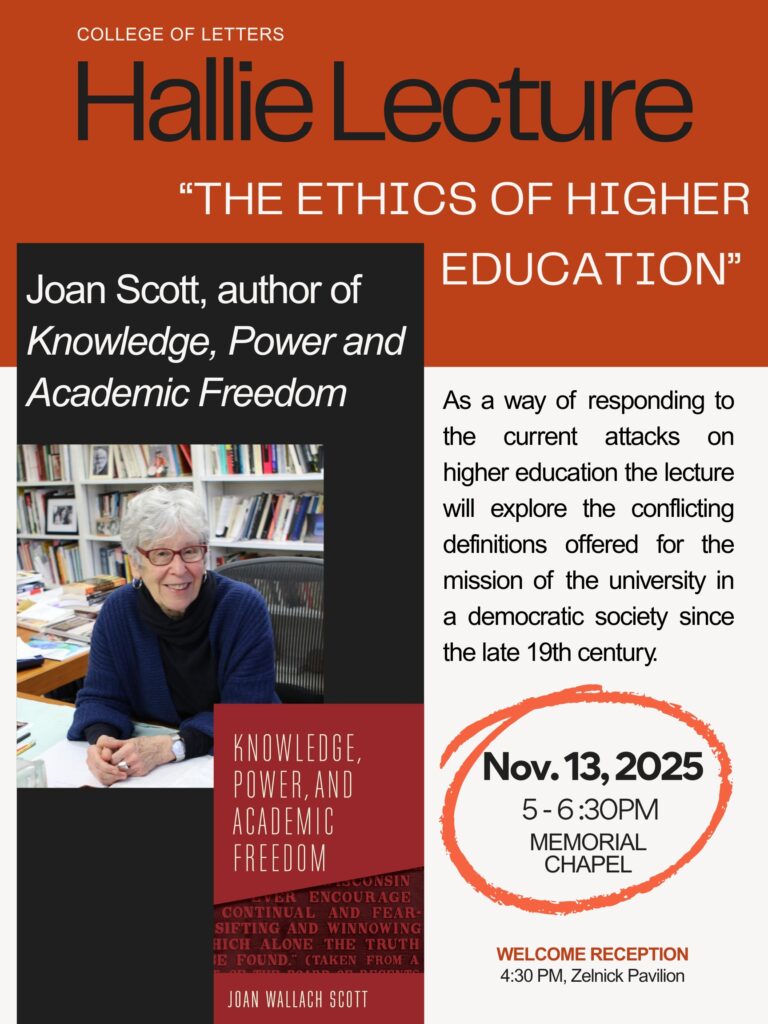
What is the role of higher education in a democratic society? How does that role change in times of academic and political repression? How does one begin to critique universities as spaces for critical thinking as well as corporate institutions? This year marked the 32nd annually held Hallie Lecture sponsored by the College of Letters, with guest speaker Joan W. Scott, author of Knowledge, Power, and Academic Freedom answering those very questions in the current context of attacks on higher education. The lecture was preceded by a Welcome Reception at Zelnick Pavillion.
“What’s always struck me most about Joan Scott’s work and about Joan herself is that ethical seriousness is under us,” Professor Ethan Kleinberg said, in his introduction of Joan Scott at the lecture. “She’s never been content with critique for its own sake. Her scholarship asked us to consider not just what we know, but how and why we know it. To recognize that the pursuit of knowledge should never be separable from questions of justice, responsibility and care. That commitment stands for lifelong defense of academic freedom and the university as a space thereof.”
Among the University’s most significant lecture series, the Hallie lecture honors Phillip Hallie, Professor Emeritus of philosophy and the humanities, and his best known work ‘Lest Innocent blood be Shed’, which explored good, evil, choice, and circumstance in the case of French Huguenot villagers during German occupation in World War II.
Joan Scott began by outlining the challenges facing higher education and democratic society today: from the acquiescence of prestigious universities to federal oversight of curriculum, the elimination of Diversity, Equity, and Inclusion practises, the capitulation to Zionist demands that critics of Israel be punished as anti-semites, the failure to protect international students facing visa revocals, to the repression of faculty and student protestors’ free speech.
Joan Scott gave historic examples of higher education institutes compromising on their mission— during the rise of the Nazi Party in Germany in the 1930s, to the ousting of faculty as suspected communists under McCarthyism across the United States in the 1950s. Calling attention to a deal for expanded federal funding that the White House offered nine universities in exchange for implementing educational policies in October, Scott spoke about viewpoint diversity in the classroom.
“It’s no accident that the Compact issued in October seeks to impose viewpoint diversity [in the academy],” Scott said, adding that viewpoint diversity from the authoritarian administration’s point of view assumes that viewpoints are fixed, as the property of individuals whose minds aren’t changed by the influence of education. “Their viewpoint of diversity was a perversion of the university’s mission, an attempt to put political boundaries in the classroom in order to substitute biological inoculation for the ethically driven pursuit of knowledge.”
Speaking to the reality of U.S. universities dealing with these demands, Scott drew a line between mere compliance and ‘negotiating’, finding ways to accommodate demands to avoid the worst repercussions.
Nonetheless, Scott maintained, “The idea that signing on with the fascist then or now is a way of protecting the University is delusional.” Rather, Scott defined the role of the University as ennobling and training democratic citizens. Scott referenced Michel de Certeau’s definition of Ethics, articulated through effective operations, and it defines the distance between ‘what is’ and ‘what ought to be’. The distance signifies a space where we have ‘something to do’.
“I want to argue that higher education takes place in that space,” Scott said. “The ‘something to do’ is the critical work of knowledge production that enables us to get from what is to what ought to be. The ‘what is’ is our present knowledge, its limited ability to address social, political, or intellectual problems, to explain fully the distance between the democratic principles we aspire to and the realities that organize our lives… We don’t know what that ought to be is, but we might get there. ”
Scott then highlighted the importance of ‘critique’ as an impulse of our unquenchable desire to know, an intellectual instrument that refuses to be sated with present reality, training democratic citizens to be critical thinkers.
“So first, desire,” Scott said. “I define the ethics of higher education as the cultivation of a relentless desire to learn more and better than you do now. Education at once unleashes and channels this desire for truth. Study turns one into a student, which is to say someone whose desire is structured by the voluntary assumption of limits unassailable and affable, limits that entail distinctions of true and false.”
This critique can be disruptive too, calling into question ethical values, as well as the interests they might serve. This begged the question: Can critique go too far?
“The scholars who founded the American Association of University Professors in 1915 understood this unsettling to be the mission of a democratic education,” Scott said, dissecting the genealogy of University administrators and faculty engaging in ‘Academic Freedom’ under free speech among its other tenets, as well as responding, reacting and organising when these freedoms were encroached upon.
“In a way perversely, academic freedom was denied to professors with dissident political beliefs. Visited political beliefs in the name of academic freedom, and perversely, yet again, universities carried out the wills of government in the name of academic freedom, that is to prevent interference by politicians and so protect their claim to institutional independence,” Scott said.
Scott spoke about the balancing calculus of a University’s state and corporate interests— when knowledge production shaped federal initiatives, begetting at the same time from federal funding, making the balance of state control and institutional independence difficult to accomplish.
Closing the lecture, Scott clarified once again that what she was offering was a “utopian manifesto”, a set of ideals that challenges the various critiques of universities. Academic freedom is one of those ideals. “My vision of academic freedom harkens back to the progressives and considers that its job is to protect the most diverse of critics, those whose questioning induces vertigo [in] anyone who thinks one is good enough or unalterable. Those who challenge the orthodoxies of their disciplines, the limits of political rule, and accept ideas as unpowerful.”
Attendants asked questions about the current role of the AAUP, the connections drawn between Executive Orders in relation to distorting science and gender, and the methodology of critiquing one’s own values. Attendants, faculty, and Professor Scott then convened for a dinner after the lecture, in the Daniel Family Commons.
Written by COL Major Janhavi Munde, ’27
On Nov. 5, the College of Letters co-sponsored a lecture on “Animal Houses” by guest speaker Trattie Davies, who is an Architect and Senior Critic at the Yale School of Architecture. “Animal Houses” is also a course Davies teaches MA students, exploring the visualisation of space from the perspective and function of non-human animals. The event was held in Boger Room 112.
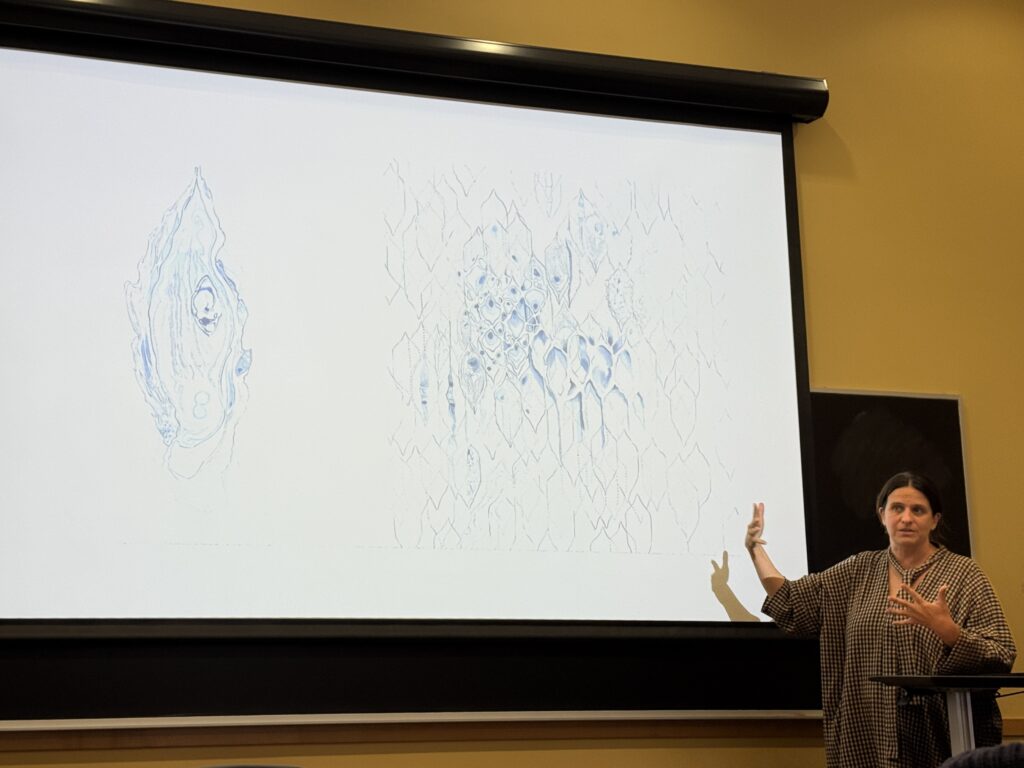
Davies began her presentation with an excerpt from German artist Josef Albersm, which she said makes no sense upon first read but stretches open possibilities for thinking about art and design :
“One and one is two—that’s business.
One and one is four—that’s art—or if you like it better—is life.
I think that makes clear: the many-fold seeing, the many-fold reading of the world makes us broader; wider; richer.
In education, a single standpoint cannot give a solid firm stand.
Thus, let us have different viewpoints, different standpoints.
Let us observe in different directions and from different angles…”
Davies then exemplified the value of looking at architecture from multiple perspectives by presenting two photographs of Swiss-French architect designer Le Corbusier’s “Villa Garches”, a built example of Corbusier’s five points of architecture. The first photograph presented the traditional view of the Villa alone, a model that was to be respected and related.
The second photograph looked at the same model from a different perspective: the weather had changed, the photographer had moved further back, however, Davies called “an awkward view”, where the photographer had moved back, and one could see the occupants engaging in a snowball fight.
“The question is raised, how does life actually take place in space?” Davies asked, adding that closer observation of human spaces becomes more important to understand occupants’ lived history. For non-human animals, however, the case is entirely different.
“But if you look at animals— immediately, the questions of life are vivid and clear. A few years ago, I was like, ‘What is up with animal houses?’ and I had some old students [with me]. And the task was, pick an animal and then let’s meet and discuss.”
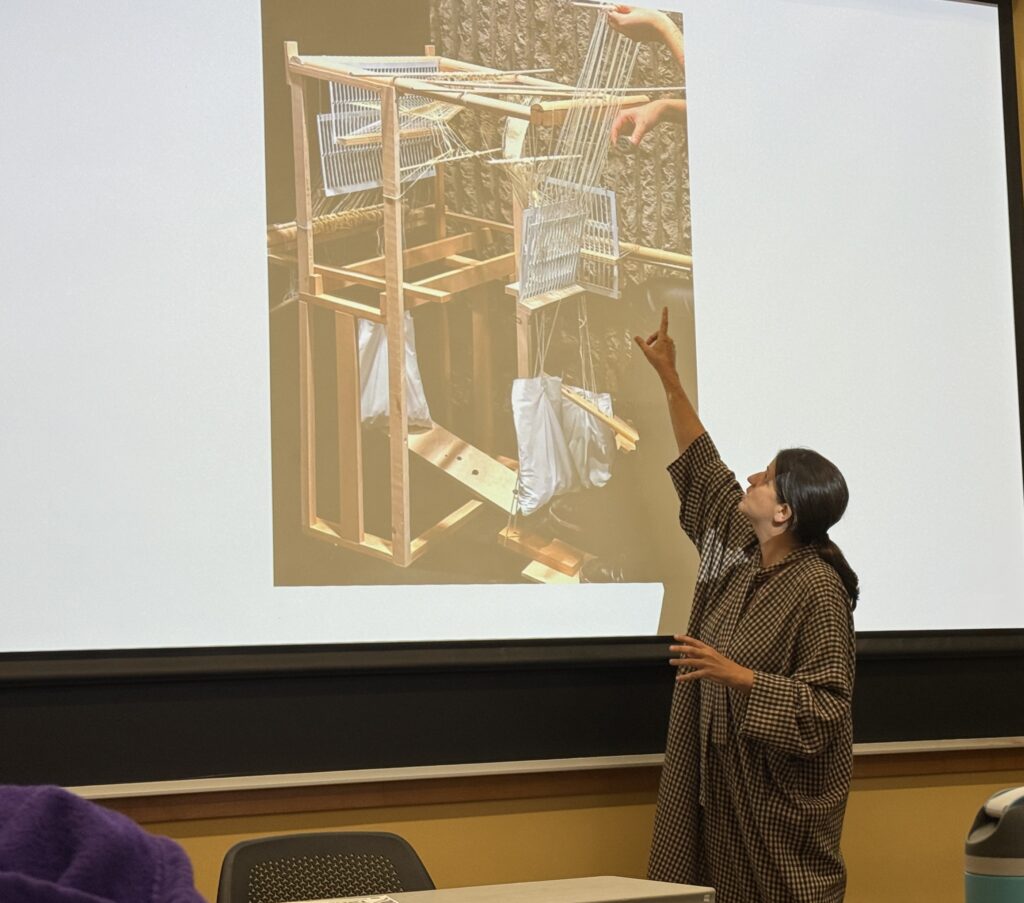
Then Davies transitioned into explaining her students’ final presentation for the course— a collection that ranged from graphic art, audio-visual material, architectural designs, as well handmade woodwork. Students explored how animals occupied space, both temporarily and habitually, through case studies of fire ants, sea sponges, wasp nests, birds, and elk among others.
One example explored the life cycle of the green darner, a dragonfly species found abundantly in North America.
“It’s very hard to piece together this particular animal because it takes three generations to complete its migratory pattern,” Davies said.
It only spends 4 months of its life in flight, and the student presenting assembled the building typologies of the spaces through which the different generations would pass, allowing for a view of the continuum of movement.
Towards the end of the lecture, attendants asked questions about the kinds of material students used to construct their projects, the methodology they used to study behaviours of any given animals, and Davies’ main takeaways from this course.
“For me, architectural design is like putting your foot in the water of a stream just by touching it. You incite an adjustment every day. It is an act of enormous control, with impact on every moment of our existence,” Davies said.
Written by COL Major Janhavi Munde, ’27
“What is a Ruin?”
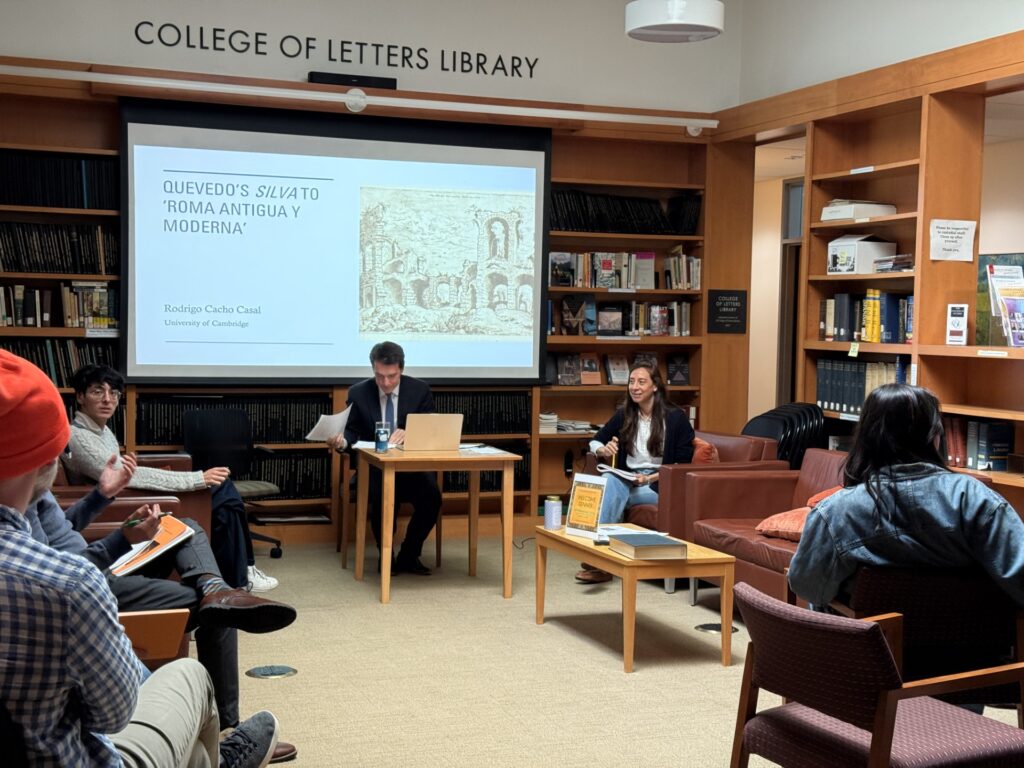
On October 15th, the College of Letters hosted a masterclass in the COL library with Professor Rodrigo Cacho, who teaches Early Modern Iberian and Latin American Literature at the University of Cambridge. The masterclass facilitated a guided reading and discussion of Baroque author Francisco de Quevedo’s silva to “Roma antigua y moderna”. Prior to the masterclass, Professor Cacho joined COL juniors in discussing the silva in the Early Modern Period colloquium taught by Professor Ponce-Hegenauer and Professor Plass.
Professor Cacho terms the silva “complex rewriting” of French Joachim du Bellay’s “Antiquitez de Rome”, a selection of poetry that COL juniors had also recently read and discussed in colloquium.
“What is a Ruin?” was Professor Cacho’s question to attendants, kicking off the lecture. Responses ranged from remnants of a historic structure, to a material entrypoint for the onlooker into the history of the ruin. Guiding attendants through the nuances of the English translation and the intertextual artistic tradition within which Quevedo was writing, Professor Cacho unpacked how the text constructs memory, empire, and the transmission of culture by using “Rome” as a symbol for the achievements of Latin literature within the classical tradition, among other tenors. Students also gained an understanding of the transformation of literary traditions from the Renaissance period to the Baroque by reading the two authors.
The lecture facilitated close readings focussing on various figures and symbols within the text: the Tiber and other rivers, Lamia and Flora as mythical figures, as well as the role of the newcomer in understanding how Quevedo poeticises a timeless understanding of the history of Rome.
“The city described by Du Bellay and Quevedo is as much a historical artifact as a metaphysical one. Rome is a metaphor for knowledge, which is both an endless archive of memory and a space for creativity… The author is looking at history with the universal eyes of memory as it was conceived in Platonic terms. All times are but one time, all art is but one art.” Professor Cacho wrote in his paper, “The Memory of Ruins: Quevedo’s Silva to “Roma antigua y moderna”, which juniors read as supplementary reading alongside Quevedo’s silva.
The silva begins by addressing an undefined newcomer beholding Rome’s ruins. As most COL juniors themselves were new readers of Du Bellay and Quevedo, they shared how the masterclass further informed their readings.
“The lecture guided me through the reading and inspired me to think so much more about the poem and its effects,” said Cassie Wo ’27, a COL junior.
“I really enjoyed hearing about Cacho’s comparison of the content of Quevedo’s “Roma, Moderna y Antigua” and the form used to represent it. More specifically, the dichotomy between the antiquity of the Roman ruins and the modernity (at the time) of the metric form of the Silva, which was even considered experimental or avant garde,” said Ben Schietinger ’27, also a COL junior, who had presented on the silva in colloquium.
After the lecture, students met with Professor Cacho to discuss their own readings of the text and ask questions.
Written by COL Major Janhavi Munde, ’27
The College of Letters 32nd Annual Philip Hallie Lecture, November 13, 2025
A College of Letters Masterclass – Fall 2025
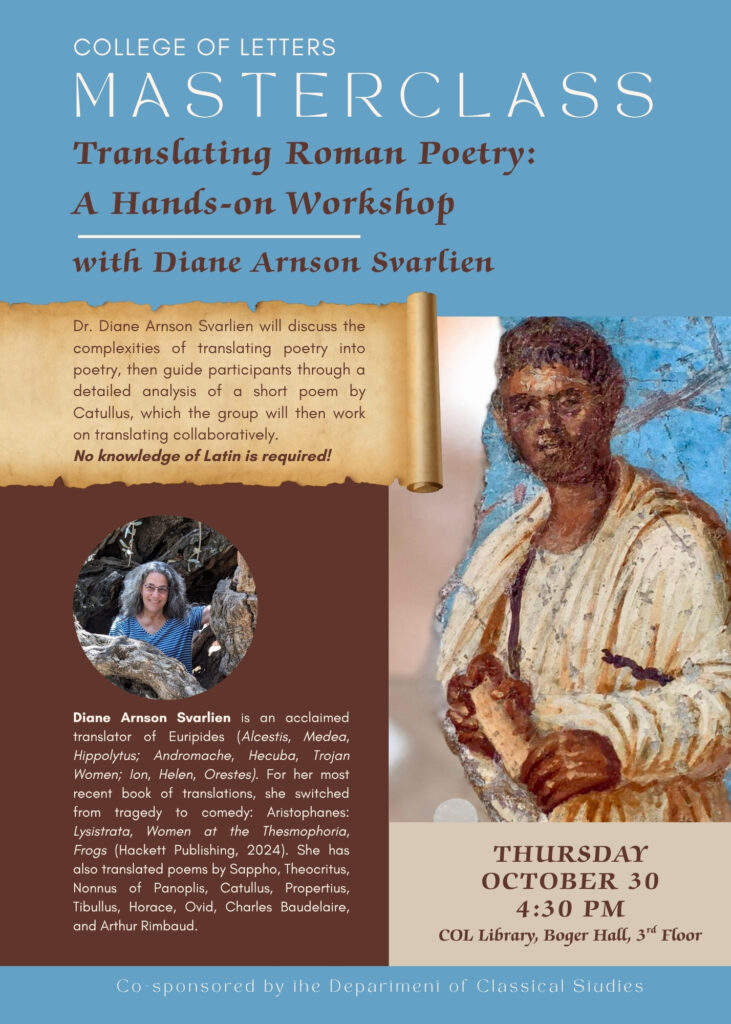
A College of Letters Masterclass – Fall 2025
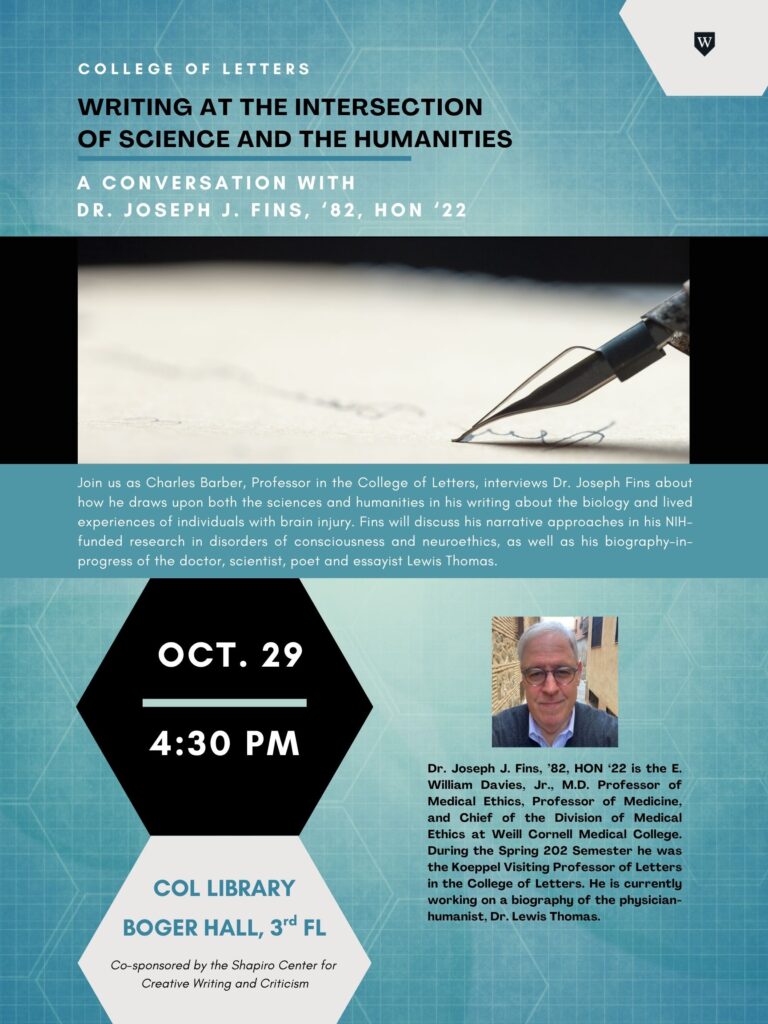
Learn all about our major from Faculty & Staff!